
cAMP-related second messenger pathways modulate hearing function in Aedes aegypti mosquitoes
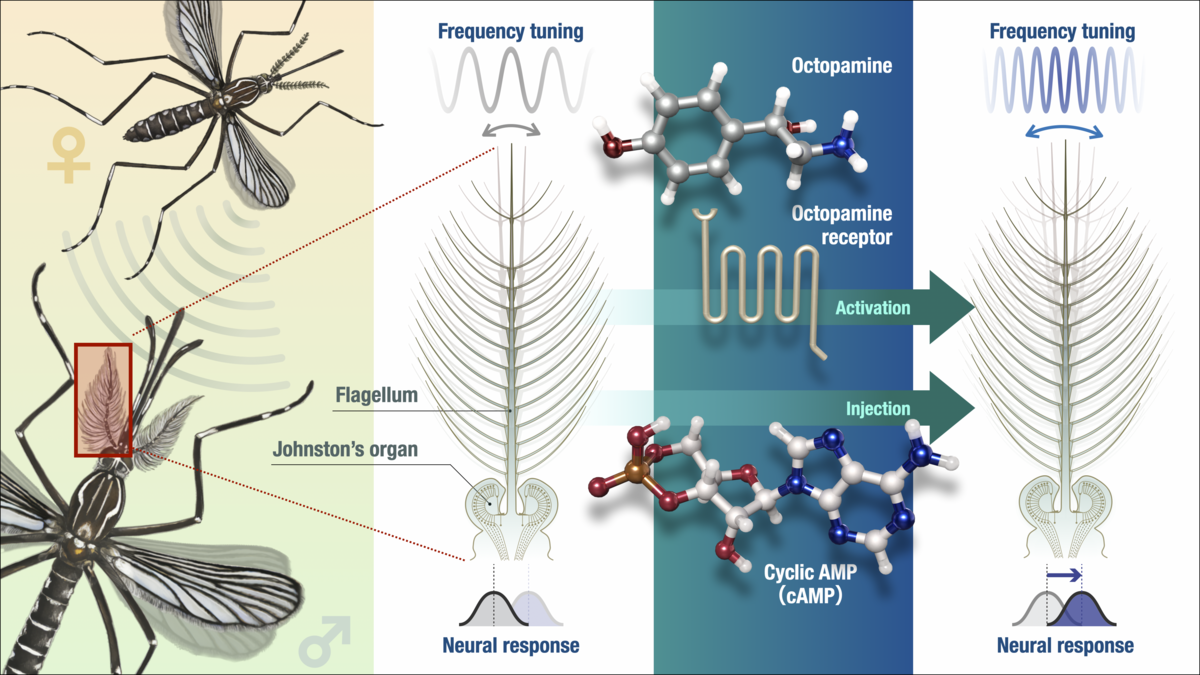
Mosquitoes transmit a variety of infectious diseases worldwide and are responsible for more human deaths than any other animal. For mosquitoes, hearing is essential for successful mating as male mosquitoes rely on the wingbeat sound of females to locate mating partners. For this reason, manipulating mosquito auditory function has attracted attention as a potential new strategy for controlling mosquito reproduction. To this end, a research group led by Professor Azusa Kamikouchi, Assistant Professor Matthew Su, and YiFeng Y.J. Xu at the Graduate School of Science, Nagoya University, and the Institute of Transformative Bio-Molecules (WPI-ITbM), has clarified part of the mechanism by which the neurotransmitter octopamine regulates the function of the auditory organ in male Aedes aegypti mosquitoes (which spread pathogens including the dengue and Zika viruses). This research was published in iScience on July 24, 2025.
Many species of mosquitoes form aerial swarms that serve as meeting sites. Most individuals in these swarms are males and when a female enters, males rapidly approach and attempt to mate while flying. To find these females in such a male-dominated environment, the female wingbeat sound acts as an essential cue. Male mosquitoes possess highly sensitive hearing and can detect even faint female wingbeat sounds, quickly orienting toward the source.
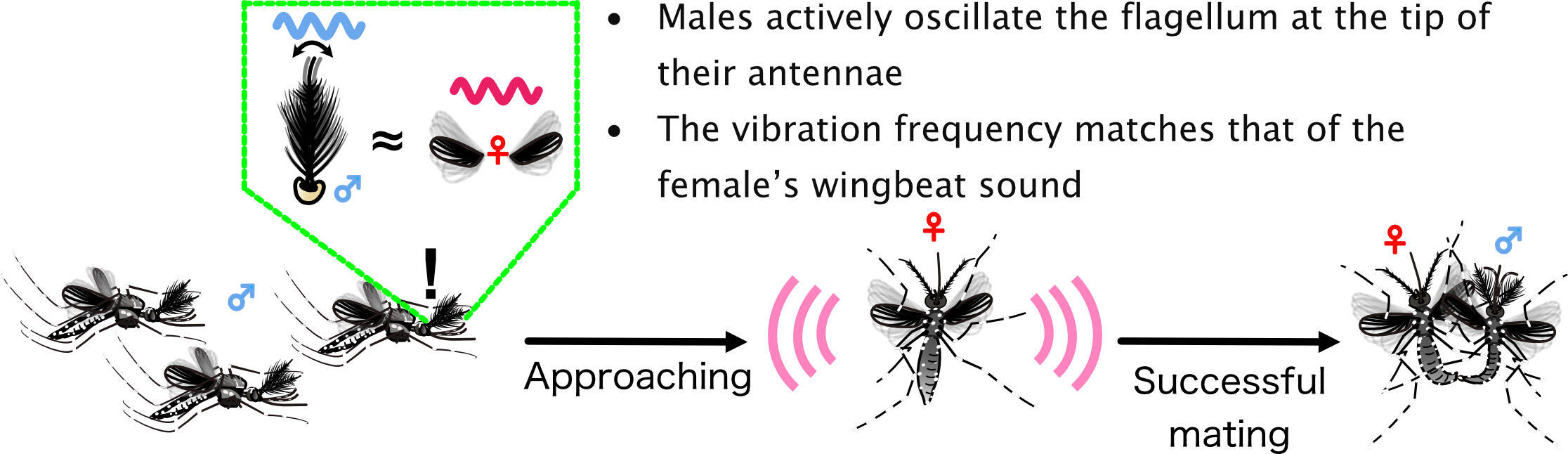
Mating behavior in mosquitoes. Males detect the female wingbeat sound, approach the female, and proceed to mating. Males actively oscillate the flagellum--the distal segment of the antenna--to increase sensitivity to the female wingbeat sound.
The mosquito auditory system consists of the Johnston's organ, located at the base of the antenna and analogous to the human cochlea, and the flagellum, the tip of the antenna, that is analogous to the human eardrum.
Males enhance their sensitivity to females by actively oscillating their flagella at frequencies close to female wingbeat sounds. In this way, they can tune the frequency characteristics of their auditory system and respond selectively to specific sound frequencies.
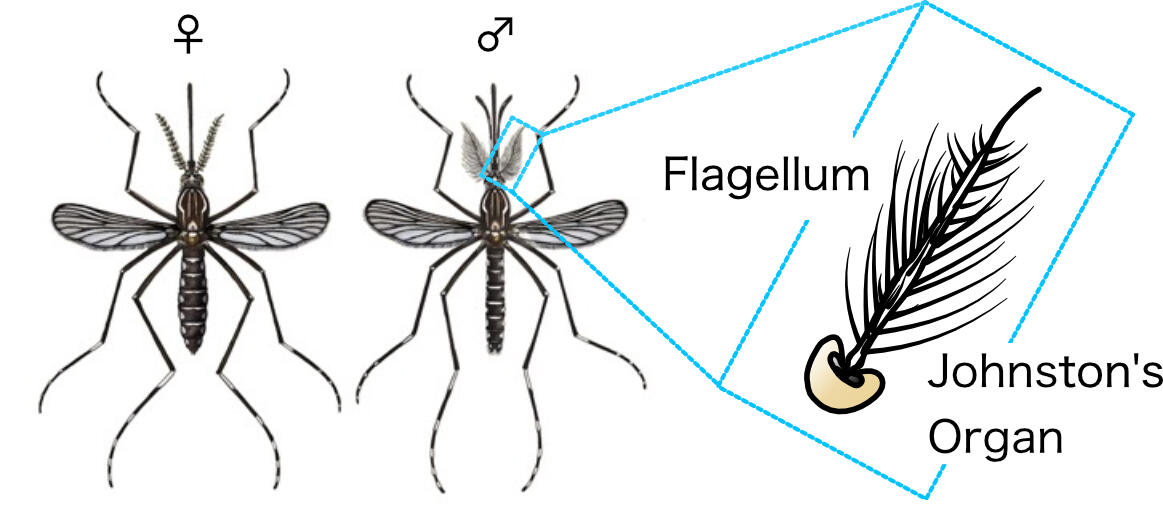
Auditory organ of Aedes aegypti. The Johnston's organ at the base of the antenna and the flagellum at the tip are responsible for sound reception. The male auditory organ is more complex than that of the female.
Previously, researchers demonstrated that octopamine, a neurotransmitter functionally analogous to norepinephrine in mammals, regulates auditory function. However, the detailed mechanism underlying this regulation remained unclear. In this study, the team clarified the effects and mechanism by which octopamine regulates male Aedes aegypti mosquito hearing function. By administering compounds to mosquitoes that either activate (octopamine and clonidine) or inhibit (epinastine) their octopamine receptors, they could change both the frequency characteristics and neural responses of the mosquito auditory system. Octopamine effectively induced stronger responses to higher-frequency vibrations, demonstrating that mosquito auditory systems can be chemically manipulated.
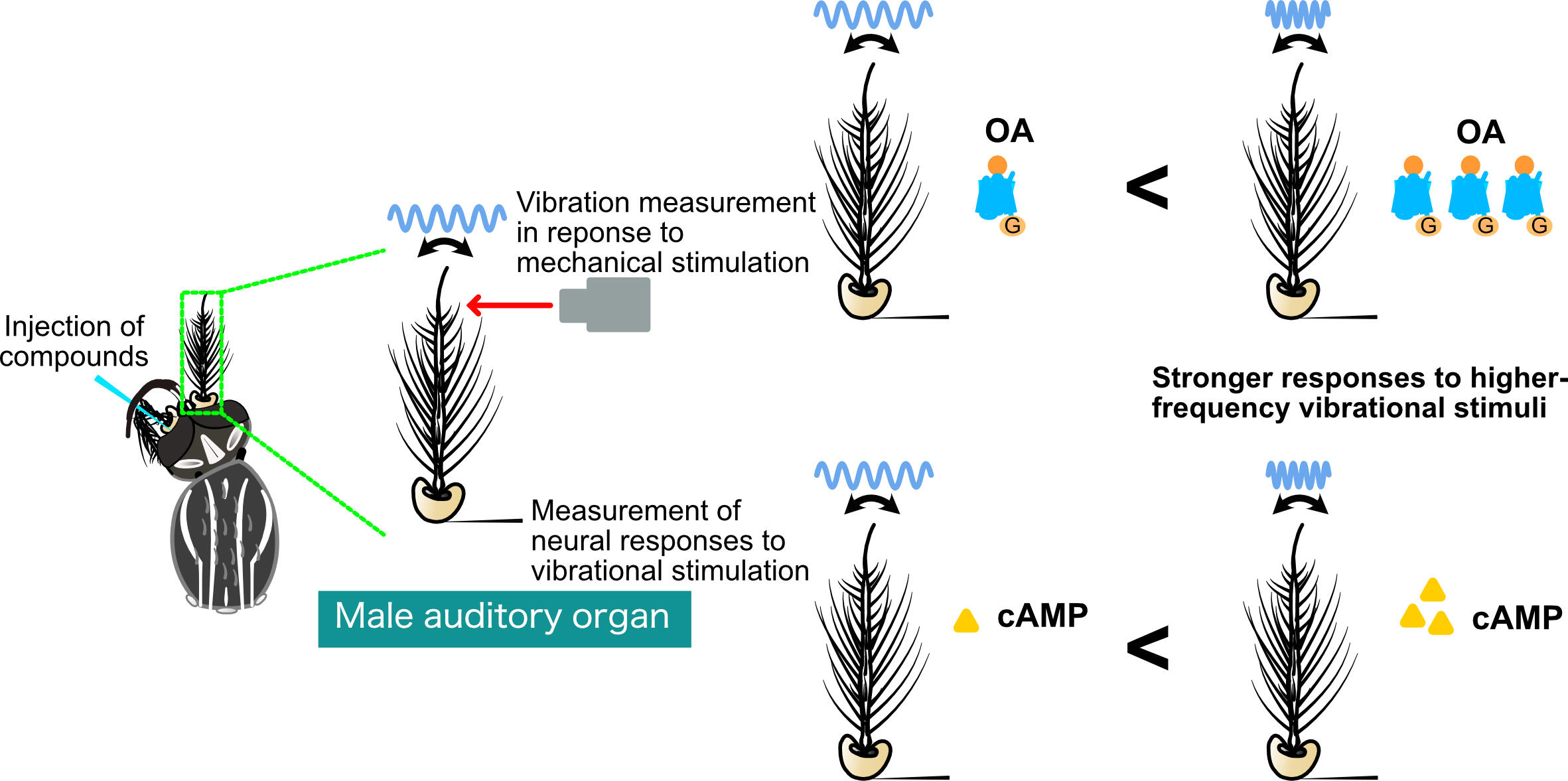
Vibrations and neural responses of the male auditory organ were measured in response to vibrational stimulation. Administration of octopamine (OA) or cAMP enhanced responses to higher-frequency vibrational stimuli.
Sequential dual injection of two distinct octopamine receptor antagonists, epinastine and phentolamine, following clonidine treatment, supported that the effects of octopamine are receptor mediated. Further experimentation suggested the effects are mediated by the intracellular second messenger cAMP, which is produced upon activation of the octopamine receptors. Notably, direct injection of cAMP into mosquitoes produced similar changes in auditory function as injection of octopamine.
In addition to these findings, it was observed that octopamine affects the posture of hair-like structures on the male flagellum. However, this change was shown not to be directly related to the frequency characteristics of the auditory organ.
This study demonstrates that mosquito auditory function is flexibly regulated by the neurotransmitter octopamine and downstream intracellular signaling pathways. It also shows that auditory function can be controlled through the administration of specific compounds. The research group has previously reported that another neurotransmitter, serotonin, also regulates auditory function in Aedes aegypti. Together, these findings suggest that multiple neurotransmitters act in combination to regulate mosquito hearing.
These results are expected to represent an important step toward the development of new mosquito control strategies targeting auditory function.
Information
| Title | cAMP-related second messenger pathways modulate hearing function in Aedes aegypti mosquitoes |
|---|---|
| Author | YiFeng Y.J. Xu, YuMin M. Loh, Tai-Ting Lee, Wan-Tze Chen, WenWei Loh, Takuro S. Ohashi, Daniel F. Eberl, Marta Andrés, Matthew P. Su, and Azusa Kamikouchi |
| Journal | iScience |
| DOI | 10.1016/j.isci.2025.113202 |
| Date | 2025.7 |