
AI and quantum chemistry identify efficient blue OLED materials
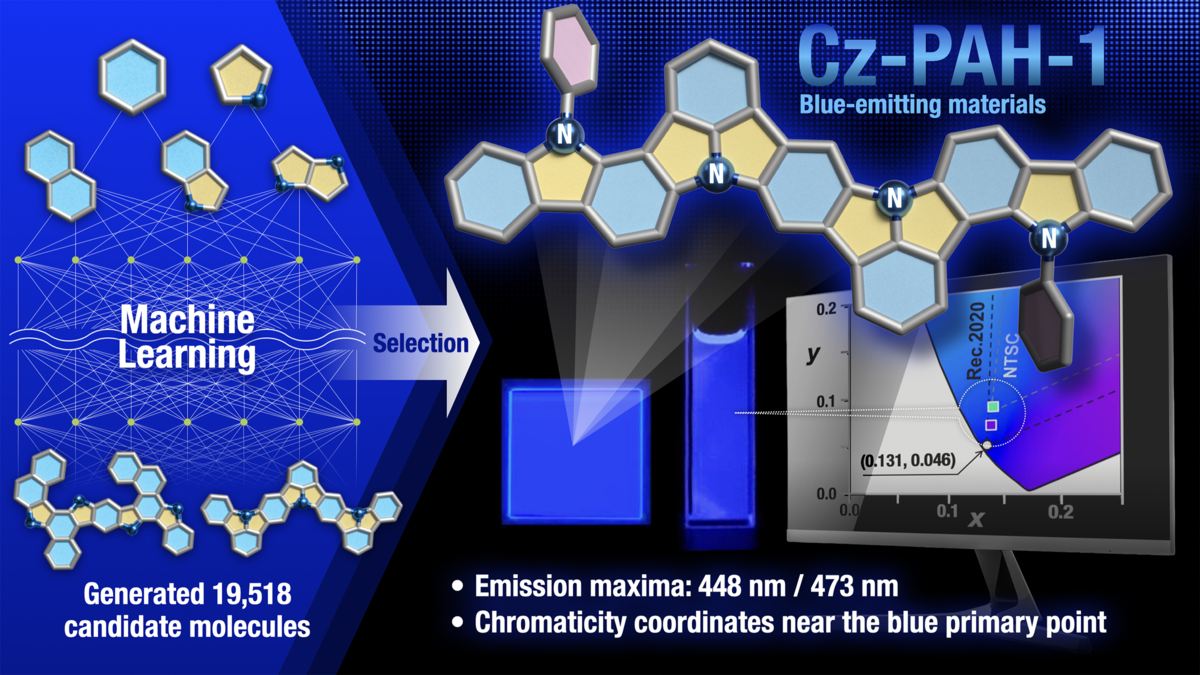
Researchers designed an end-to-end workflow from molecular design to blue OLED device fabrication and evaluation
Organic light-emitting diodes (OLEDs) have become a standard in modern devices with incredible contrast and sleek designs. While initially an expensive luxury, OLEDs are gradually becoming more financially accessible as the technology improves. Now, researchers at the Institute of Transformative Bio-Molecules (WPI-ITbM) at Nagoya University and the Institute for Advanced Study at Kyushu University have combined quantum chemistry with machine learning to identify new materials for blue OLEDs to incorporate in next-generation ultra-high-definition displays. Their research was published in Angewandte Chemie International Edition on July 21, 2026.
Blue pixels waste energy
While OLEDs are primarily composed of organic molecules, many high-efficiency red and green pixels incorporate heavy metals, such as iridium, to improve their efficiency. Such phosphorescent emitters can achieve nearly 100% internal quantum efficiency; however, conventional fluorescent blue pixels are capped at 25%. Blue pixels often use completely organic emitters because blue light requires significantly higher excited-state energy. Iridium-based emitters could also raise the efficiency of blue pixels; however, the high excited-state energy can accelerate molecular degradation, shortening the pixel lifetime.
Next generation blue pixels
The limited efficiency of conventional fluorescent blue OLEDs is due to their different excited states (i.e. higher energy state) formed when an electric field is applied across them. Only 25% of the resulting excited states can directly emit light. Therefore, next-generation OLED displays may incorporate thermally activated delayed fluorescence (TADF) molecules into blue pixels. TADF molecules are advanced organic molecules that use ambient thermal energy to convert non-emissive excited states into light-emitting states. That said, these TADF molecules need to be readily synthesized and have high color purity and high emission efficiency.
Artificial intelligence and quantum chemistry
Many leading TADF emitters use boron-containing molecular frameworks, which can be synthetically demanding to construct. To overcome this, the researchers focused on "boron-free" 13-ring frameworks systematically enumerated from combinations of five- and six-membered rings under defined chemical constraints. By strictly restricting the molecules to contain only carbon, hydrogen, and nitrogen atoms, they generated a virtual library with more than 19,000 molecules that satisfied all their chemical constraints and analyzed them with a combination of quantum chemistry and machine learning.
Quantum chemical calculations can accurately predict molecular properties; however, applying them to an enormous number of molecules incurs substantial computational costs. In contrast, machine learning enables rapid evaluation of large candidate sets but require training data. To generate these data, they randomly selected 1,000 molecules from the over 19,000-candidate library and calculated energy parameters relevant to TADF using quantum chemistry, generating the labeled dataset for machine learning.
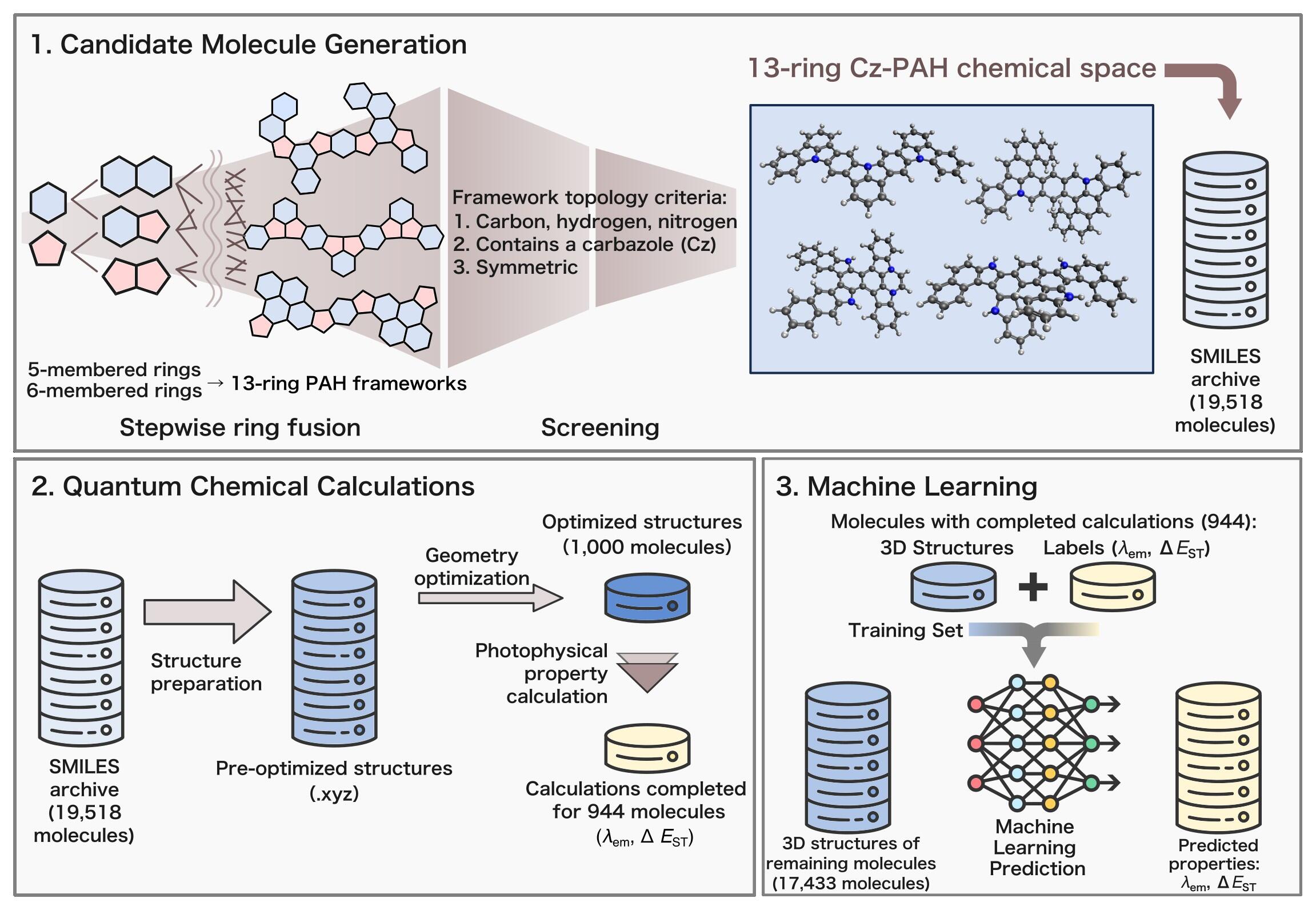
Combined quantum chemistry and machine learning approach.
They applied the trained model to over 17,000 molecules whose 3D structures could be prepared, enabling large-scale screening with substantially reduced computational cost. Among the over 17,000 analyzed molecules, they first selected 50 promising candidates for higher-level quantum chemical calculations. After further considering their calculated properties and synthetic feasibility, they selected two molecules to synthesize and proceeded with experimental evaluation.
Both molecules exhibited vivid blue emission with narrow bandwidths (i.e., high color purity). Additionally, their photoluminescence quantum yields in thin films reached nearly 100% (93-99%), indicating highly efficient light emission. The researchers fabricated OLED devices using the two molecules, and the resulting devices produced highly pure blue emissions. A device based on Cz-PAH-1 approached the blue-primary color defined by the next-generation Rec. 2020 ultra-high-definition display standard, while a device using Cz-PAH-2 achieved an exceptionally high maximum external quantum efficiency of 35.2%.
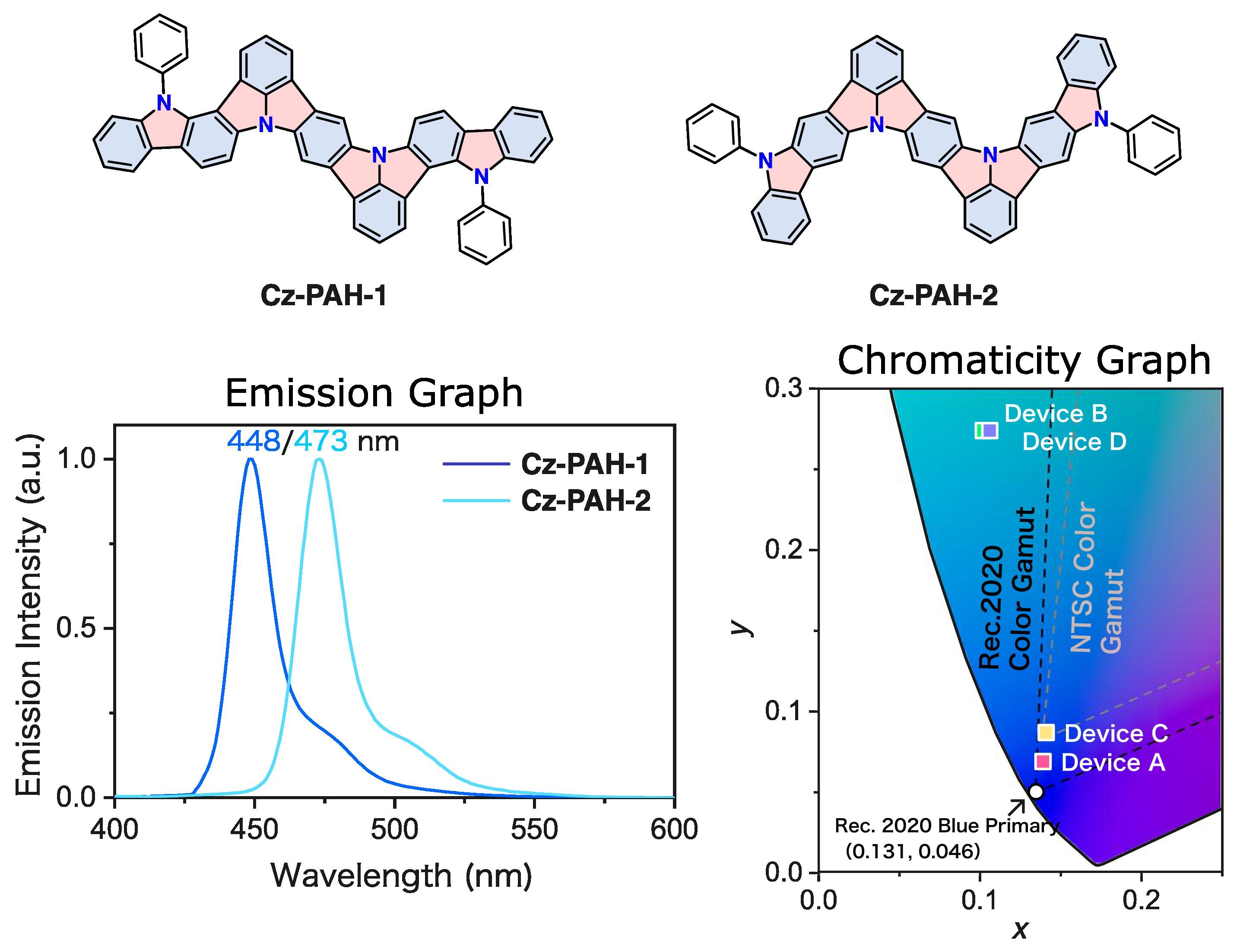
Synthesized TADF molecules with corresponding photophysical properties and OLED device performance.
Broader significance
A key innovation of this work lies in integrating large-scale virtual molecule generation, quantum chemical calculations, machine learning-based screening, molecular synthesis, photophysical characterization, and device evaluation into a single continuous discovery pipeline. Using two newly developed molecules, the researchers demonstrated that machine learning-based candidate selection can be successfully translated into experimentally validated materials development.
The methodology demonstrated here can readily be extended to the efficient discovery of other classes of organic functional materials with enormous molecular design spaces, facilitating the identification of promising candidates for future OLED applications.
Information
| Title | Machine-Learning-Guided Discovery of Boron-Free Narrowband Blue Thermally Activated Delayed Fluorescence Emitters |
|---|---|
| Author | Masaya Hakai, Jie Sun, Jun Hyeon Lee, Kazuhiro Fujimoto, Shigehiro Yamaguchi, Takuma Yasuda, and Takeshi Yanai |
| Journal | Angewandte Chemie International Edition |
| DOI | 10.1002/ange.2731055 |
| Date | 2026.7 |